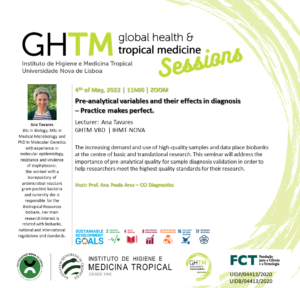
The increasing demand and use of high-quality samples and data place biobanks at the centre of basic and translational research. This seminar will address the importance of pre-analytical quality for sample diagnosis validation in order to help researchers meet the highest quality standards for their research.
Read More
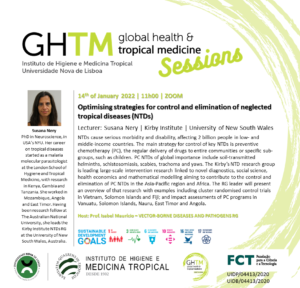
GHTM Sessions 2022 VBD01 » Optimising strategies for control and elimination of neglected tropical diseases (NTDs)
NTDs cause serious morbidity and disability, affecting 2 billion people in low- and middle-income countries. The main strategy for control of key NTDs is preventive chemotherapy (PC), the regular delivery of drugs to entire communities or specific sub-groups, such as children. PC NTDs of global importance include soil-transmitted helminths, schistosomiasis, scabies, trachoma and yaws. The Kirby’s NTD research group is leading large-scale intervention research linked to novel diagnostics, social science, health economics and mathematical modelling aiming to contribute to the control and elimination of PC NTDs in the Asia-Pacific region and Africa. The RG leader will present an overview of that research with examples including cluster randomised control trials in Vietnam, Solomon Islands and Fiji; and impact assessments of PC programs in Vanuatu, Solomon Islands, Nauru, East Timor and Angola.
Read More
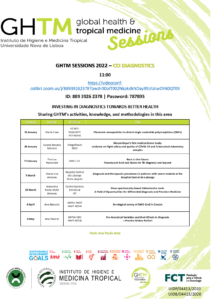
GHTM Sessions 2022 CCI Diagnostics » 1st Semester Calendar
GHTM Sessions 2022 CCI Diagnostics » Year Calendar » Sharing GHTM’s Cross Cutting Issues Diagnostics’ activities, knowledge and methodologies in this area.
Read More
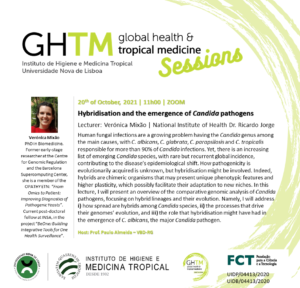
GHTM Sessions 2021 VBD01 » Hybridisation and the emergence of Candida pathogens
Human fungal infections are a growing problem having the Candida genus among the main causes. This lecture is an overview of the comparative genomic analysis of Candida pathogens, focusing on hybrid lineages and their evolution, addressing i) how spread are hybrids among Candida species, ii) the processes that drive their genomes’ evolution, and iii) the role that hybridisation might have had in the emergence of C. albicans, the major Candida pathogen.
Read More
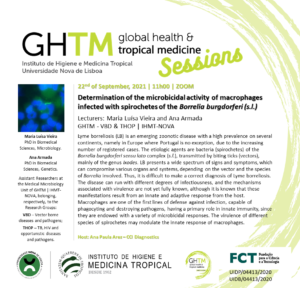
GHTM Sessions 2021 CCID11 » Determination of the microbicidal activity of macrophages infected with spirochetes of the Borrelia burgdorferi (s.l.)
Lyme borreliosis (LB) is an emerging zoonotic disease with a high prevalence on several continents, namely in Europe where Portugal is no exception, due to the increasing number of registered cases. The etiologic agents are bacteria (spirochetes) of the Borrelia burgdorferi sensu lato complex (s.l.), transmitted by biting ticks (vectors), mainly of the genus Ixodes.
Read More