GHTM

Global Health and Tropical Medicine

  • GHTM
    • About GHTM
    • Governance
    • Impact
    • Members
    • Scientific Advisory Board
    • Reports
      • GHTM
  • Research
    • Cross-cutting issues
      • Genomic Surveillance and Population Mobility
      • Antimicrobial Resistance and Drug Discovery
      • Host–Pathogen Interactions
      • Information for Health Development
      • Fair Research Partnerships
    • Research Groups
      • PPS – Population health, policies and services
      • PRIME – Pathogen resistance, infection and molecular epidemiology
      • VBD – Vector borne diseases
      • CTM – Clinical tropical medicine
    • Research in numbers
      • 2023
      • 2022
      • 2021
      • 2020
      • 2019
      • 2018
      • 2017
    • Projects
      • Ongoing Projects
      • Completed Projects
  • Outreach
    • Events
    • News
    • Policy Support & Community Outreach
  • Publications
    • 2024
    • 2023
    • 2022
    • 2021
    • 2020
    • 2019
    • 2018
    • 2017
    • 2016
    • 2015
  • Capacity Building
    • Education
      • Master Theses
      • PhD Theses
    • International
  • Infrastructures
    • BIOHUB & Available Software
    • BIOTROP Biobank
    • VIASEF & Insectaries
  • Networks & Partnerships
Home / Articles / “Host-pathogen interactions” webinar: “high scientific quality and excellent organization”

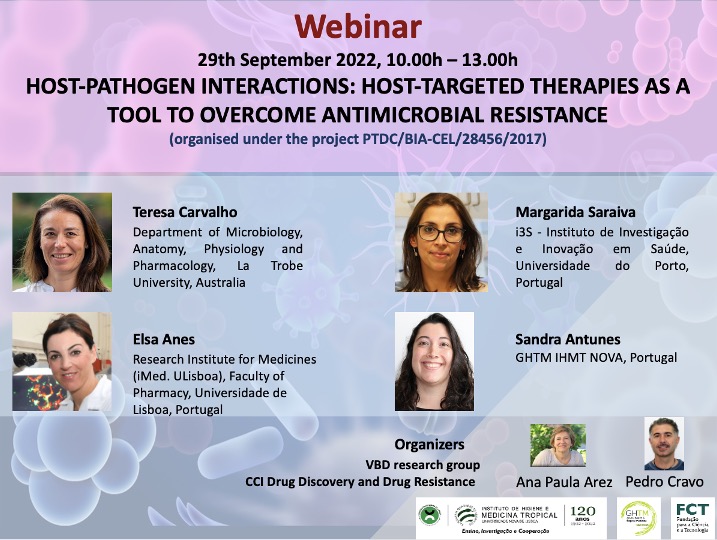
“Host-pathogen interactions” webinar: “high scientific quality and excellent organization”

October 11, 2022

“Host-pathogen interactions: Host-targeted therapies as a tool to overcome antimicrobial resistance” is the title of the webinar developed by Pedro Cravo and Ana Paula Arez, which took place on 29th September and counted with a panel of national and international experts on Immunology and Microbiology.

This webinar was based on two scientific premises on which the invited expert speakers presented their work. “First, understanding the mechanisms involved in human innate determinants of susceptibility or resistance against infection or disease may help to intervene in the host metabolic pathways that are vital to pathogen survival, and find new tools that could act via a host-mediated response rather than acting directly on the pathogen, and that, secondly, co-delivery of these tools with a conventional antimicrobial agent may contribute to overcome drug resistance”, explained the researchers from VBD-GHTM and from CCI Drug Discovery and Drug Resistance.

In addition to the webinar scientific context, the “Host-pathogen interactions” webinar was important “to promote disclosure of results under the FCT project reference PTDC/BIA-CEL/28456/2017”.

The event gathered 55 participants and fostered a good interaction environment between speakers and audience. The organisers also pointed out that “both participants and speakers gave very positive feedback on the event, highlighting the scientific quality and excellent organisation” and concluded by saying “we share their opinion”.

Share this:

  • Share on Facebook (Opens in new window) Facebook
  • Share on X (Opens in new window) X
  • Share on LinkedIn (Opens in new window) LinkedIn
  • Share on Pinterest (Opens in new window) Pinterest
  • Share on WhatsApp (Opens in new window) WhatsApp
  • Print (Opens in new window) Print

About GHTM

GHTM is a R&D Unit that brings together researchers with a track record in Tropical Medicine and International & Global Health. It aims at strengthening Portugal's role as a leading partner in the development and implementation of a global health research agenda. Our evidence-based interventions contribute to the promotion of equity in health and to improve the health of populations.

Contacts

Rua da Junqueira, 100
1349-008 Lisboa
Portugal

+351 213 652 600

  • Email
  • Facebook
  • LinkedIn
  • Twitter
  • YouTube

Funding

UID/04413/2025 - DOI: 10.54499/UID/04413/2025

UID/PRR/04413/2025 - DOI: 10.54499/UID/PRR/04413/2025

UID/PRR2/04413/2025 - DOI: 10.54499/UID/PRR2/04413/2025

  • Events
  • Research Groups
  • Cross-cutting issues
© Copyright 2026 IHMT-UNL All Rights Reserved.
  • Universidade Nova de Lisboa
  • Fundação para a Ciência e a Tecnologia

    UIDB/04413/2020
    UIDP/04413/2020

Loading Comments...

    We use cookies to ensure that we give you the best experience on our website. If you continue to use this site we will assume that you are happy with it.